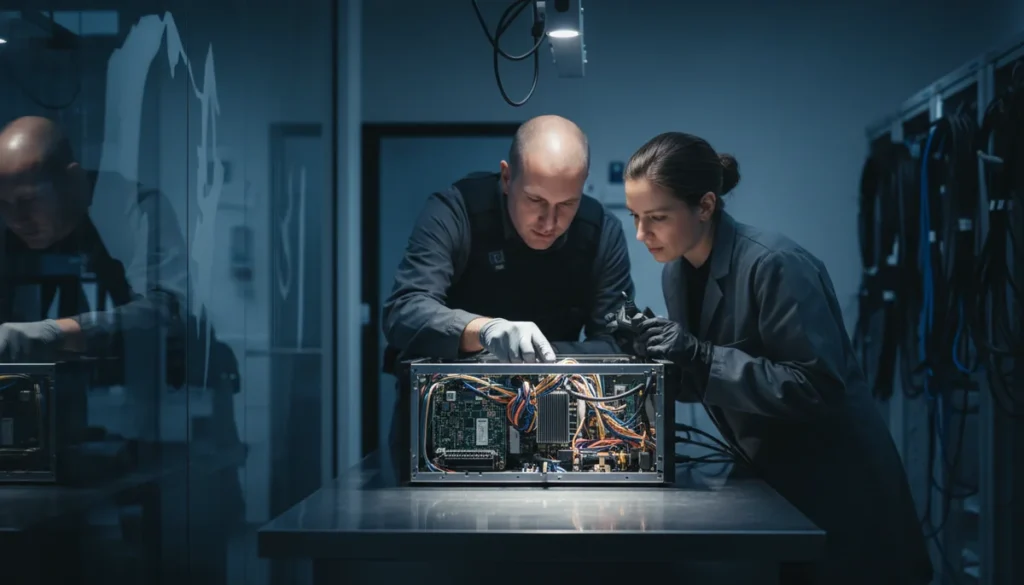
GPT-5.5 Codex AI Agents Are Changing How NVIDIA’s 10,000 Engineers Work
OpenAI’s GPT-5.5 Codex AI agents are here, and they are already rewriting how enterprise engineering gets done. OpenAI has launched GPT-5.5, its latest frontier model, as the engine behind Codex, its agentic coding application. The model runs on NVIDIA’s GB200 NVL72 rack-scale systems, and the early results are hard to ignore.
More than 10,000 NVIDIA employees across engineering, product, legal, marketing, finance, sales, HR, operations, and developer programs have already gained access. One engineer summed up the experience plainly, the results are “blowing my mind.”
The performance numbers back that up. NVIDIA’s GB200 NVL72 systems deliver 35x lower cost per million tokens and 50x higher token output per second per megawatt compared to prior-generation hardware. That kind of economics makes frontier-model inference practical at true enterprise scale.
The productivity gains are equally striking. Debugging cycles that once stretched across days now close in hours. Experimentation that previously took weeks turns into overnight progress, even across complex, multi-file codebases. Teams are now shipping full end-to-end features from simple natural-language prompts, with stronger reliability and far fewer wasted cycles than earlier models allowed.
NVIDIA founder and CEO Jensen Huang put it directly in a company-wide email: “Let’s jump to lightspeed. Welcome to the age of AI.”
Security was a non-negotiable part of the rollout. The Codex app supports remote Secure Shell (SSH) connections to approved cloud virtual machines, so agents work with real company data without exposing it externally. NVIDIA IT provisioned dedicated cloud VMs for every employee. Each VM gives the OpenAI GPT-5.5 Codex AI agent a secure sandbox with full auditability. A zero-data retention policy governs the entire deployment. Agents access production systems through read-only permissions via command-line interfaces and Skills, the same agentic toolkit NVIDIA uses across its internal automation workflows.
The launch also reflects a partnership more than a decade in the making. NVIDIA and OpenAI have collaborated since 2016, when Jensen Huang personally delivered the first NVIDIA DGX-1 AI supercomputer to OpenAI’s San Francisco headquarters. Since then, both companies have worked across the full AI stack. NVIDIA was a day-zero partner for OpenAI’s gpt-oss open-weight model launch, optimising model weights for NVIDIA TensorRT-LLM and frameworks including vLLM and Ollama.
Furthermore, OpenAI has committed to deploying more than 10 gigawatts of NVIDIA systems for its next-generation AI infrastructure, a build-out that will place millions of NVIDIA GPUs at the foundation of OpenAI’s model training and inference for years ahead. The two companies also serve as early silicon and codesign partners. OpenAI provides direct feedback that shapes NVIDIA’s hardware roadmap, and in return receives early access to new architectures. That relationship produced a major milestone. The joint bring-up of the first GB200 NVL72 100,000-GPU cluster, which completed multiple large-scale training runs and set a new benchmark for system-level reliability at frontier scale.
GPT-5.5, in short, is the product of that infrastructure running at full strength. The OpenAI GPT-5.5 Codex AI agent story is not just about a new model, it is about what happens when a decade of hardware partnership meets a new era of agentic AI. As Jensen Huang said, the age of AI is not coming. It is already here.