AI Tools for Kubernetes Resource Optimization That Are Saving Teams Real Money
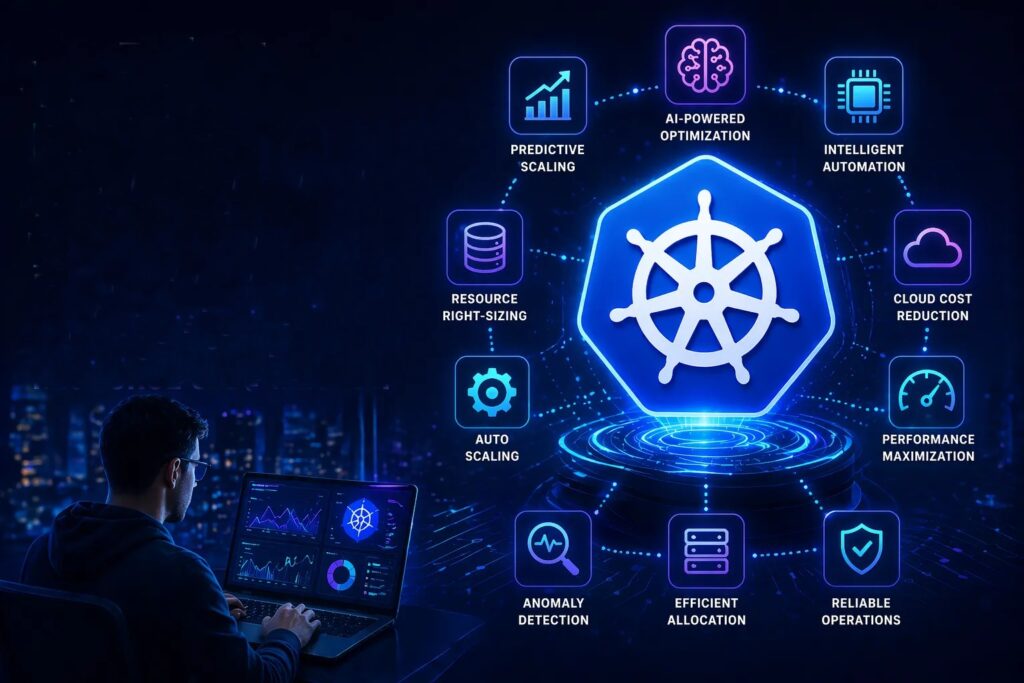
Kubernetes is powerful. Still, without smart resource management, it quietly drains cloud budgets and tanks performance. That challenge is now pushing teams toward a new class of AI tools for Kubernetes resource optimization, and the results are hard to ignore.
Manual scalability is simply ineffective. Over-provisioning wastes cloud spend. Under-provisioning, on the other hand, triggers performance breakdowns. AI and machine learning step in directly to close that gap.
Containerized workloads now account for 55% of deployed applications. Meanwhile, Kubernetes adoption has surpassed 70% among enterprises. At that scale, manual tuning is no longer viable. So which tools are leading the charge? Here are ten worth knowing.
Kubeflow tops the list for teams building ML pipelines. It is an open-source MLOps platform covering the entire machine learning lifecycle. Engineers can train models on laptops, then scale them out to massive cloud clusters, without changing workflows.
KServe pairs naturally with Kubeflow. It handles the hard parts of model serving. That includes serverless autoscaling, canary rollouts, and standardized inference protocols across TensorFlow, PyTorch, and Hugging Face.
CAST AI takes a different approach entirely. It analyzes workloads in real time and continuously adjusts infrastructure. Teams get automatic pod and node rightsizing, cheaper spot instances, and workload optimization, automatically, not just as recommendations.
KEDA (Kubernetes Event-Driven Autoscaler) expands native scaling capabilities beyond the basics. Rather than scaling only on CPU or memory, KEDA responds to real-time events from sources like RabbitMQ, AWS SQS, and Kafka. The result is cost-efficient, event-driven scaling.
VPA (Vertical Pod Autoscaler) handles right-sizing from within the cluster. Based on past usage patterns, VPA automatically adjusts CPU and memory requirements for running pods. It works alongside the Horizontal Pod Autoscaler to continuously match real-time demands.
K8sGPT brings troubleshooting intelligence straight to the terminal. It is a CNCF project that scans clusters for common problems. Moreover, it uses large language models to explain what is wrong with resources in plain English. For ops teams, that means faster diagnosis and far less guesswork.
StormForge applies machine learning directly to performance tuning. It uses Bayesian optimization and reinforcement learning to tune resource configurations. It then runs automated experiments and recommends settings that meet SLO targets at minimum cost.
Kubecost focuses on spending visibility. By integrating with Kubernetes clusters, it provides detailed cost breakdowns down to the namespace, deployment, and pod level. It then uses ML to identify savings opportunities in real time.
Sedai goes fully autonomous. It builds models of traffic, resource usage, and latency to proactively scale pods before demand spikes hit. It also detects anomalies like memory leaks and pod restarts, then applies corrective actions automatically, without human intervention.
AI-powered Cluster Autoscaler rounds out the list. Based on real-time workload requirements, it automatically adjusts Kubernetes node count. As a result, teams get just-in-time scaling and reduced cloud costs with no manual effort.
Together, these tools signal a shift in how infrastructure teams operate. A logistics company used AI to identify idle pods and reschedule workloads, cutting cloud costs by 30%. Similarly, a SaaS company reduced cluster overprovisioning by 25% through AI-based predictive scaling.
The pattern holds consistently across industries. Predictive analytics anticipate load before it arrives. Anomaly detection surfaces incidents before they reach customers. Optimization engines balance cost and performance in real time. Autonomous agents, furthermore, handle low-risk fixes under policy controls, no tickets, no on-call scrambles.
These are not futuristic promises. Teams are deploying these AI tools for Kubernetes resource optimization today. The question is no longer whether to adopt them. It is simply which ones to start with.