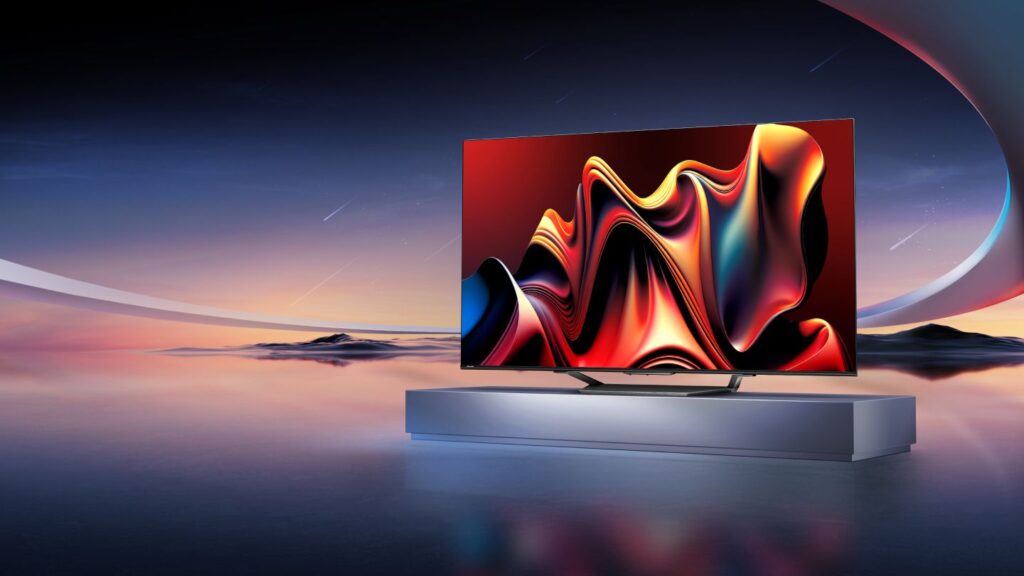
The Hisense U7SG Mini-LED TV starts at $1,299
Quick Reads
- The Hisense U7SG Mini-LED TV starts at $1,299 and packs 3,000 nits of peak brightness with a rare anti-glare coating at this price
- It runs Google TV, has four HDMI 2.1 ports, a native 165Hz panel, and the same processor found in Hisense’s pricier U8 series
- Built-in 60W Dolby Atmos speakers are good enough that many reviewers stopped reaching for their soundbars
- The one real weakness: narrow viewing angles, a known trade-off with VA MiniLED panels at this price point
There is a particular kind of frustration that comes with shopping for a TV. You find one that looks great on paper, get it home, and realise the bright afternoon sun turns it into a mirror. Or the sound is so thin you feel embarrassed watching anything with music. Or the “smart” platform loads like it is running on a potato. The Hisense U7SG does not have those problems. And that, in 2026, feels almost shocking.
The Hisense U7SG Mini-LED TV launched in March 2026 as part of Hisense’s FIFA World Cup lineup, and it is already drawing serious attention. Available in sizes from 55 to 116 inches, with the 55-inch starting at $1,299 and the 65-inch sitting at $1,499, it is not a budget TV. But for what it delivers, reviewers across the board are calling it the best value in the MiniLED category right now.
The headline feature is brightness. The Hisense U7SG Mini-LED TV hits around 3,000 nits of peak brightness, which, in a living room with afternoon sun blazing through the windows, makes a real difference. What makes it more impressive is the anti-glare coating Hisense quietly added to this model, a feature previously reserved for their higher-end sets. One reviewer tested it in a room with six large west-facing windows where every other TV they had tried turned into an unwatchable mirror between 2 pm and 5 pm. The U7SG held up without any mirror effect or washed-out darks. That is not a spec sheet claim. That is a real-life win.
Under the hood, Hisense put the Hi-View AI Engine Pro inside, the same processor from the pricier Hisense U8 series. It supports Dolby Vision, Dolby Vision IQ, Dolby Vision Gaming, HDR10, HDR10+, IMAX Enhanced, and HLG. Colour accuracy tested within 5 per cent of a calibrated professional monitor. The native 165Hz panel with four HDMI 2.1 ports means 4K/120 gaming is fully supported, which is still not standard at this price. Tom’s Guide noted this puts it squarely in the path of the LG C4 OLED and Samsung QN90D for gaming setups, both of which cost significantly more.
The audio surprised people. Hisense packed in 60W of 2.1.2-channel sound with Dolby Atmos, and more than one reviewer admitted they stopped thinking about adding a soundbar. It is not audiophile territory, but for a TV speaker system, it clears the bar most people actually care about.
The weakness comes with the MiniLED VA panel territory: viewing angles. If everyone in your household watches from directly in front of the screen, you will never notice. If you have a wide sectional sofa with seating at sharp angles from the sides, the person on the end will see colour shift and dimming. It is a real limitation, and anyone with that kind of setup should look at an OLED instead, specifically the LG C4, which handles viewing angles far better but costs considerably more. The other minor gripe is Google TV, which does show ads on the home screen. Not a dealbreaker, but worth knowing going in.
For everyone else, the Hisense U7SG Mini-LED TV is a hard set to argue against. Bright enough for any room, built well enough to not look cheap, and specced well enough to last several years through whatever gaming or streaming you throw at it. The TV market in 2026 is crowded, but this one has a real reason to exist.