SpaceX moves to go public in what could be the biggest stock listing in history
QUICK READS
- SpaceX has filed confidential paperwork with US financial regulators, taking the first formal step toward going public on the stock market.
- The company is targeting a valuation of $1.75 trillion and hopes to raise $75 billion, which would make it the largest stock market debut in history.
- Â SpaceX now operates as a conglomerate that includes its rocket and satellite businesses, the AI company xAI, and the social network X.
- Analysts say the company’s Starlink satellite internet service is the single biggest reason a $1.75 trillion price tag is even arguable.
- The IPO is internally codenamed “Project Apex” and has 21 banks lined up to manage it.
What a Confidential Filing Means
When a company files confidentially” with financial regulators, it means it is submitting the paperwork required for a public listing while keeping the details private. The regulator reviews it behind closed doors before the company officially announces to the public that it is going public. Under US rules, this can happen as little as 15 days before a company begins pitching its shares to investors. For SpaceX, that clock has now started.
The company has assembled an unusually large group of 21 banks to manage the listing, which has been given the internal codename “Project Apex,” according to Reuters. Saudi Aramco, the Saudi oil giant, held the previous record when it raised $29 billion in its 2019 listing. SpaceX would raise more than double that figure. The company has raised an estimated $10 billion as a private company across its entire history, making the scale of ambition here genuinely extraordinary.
What SpaceX Actually Is Now
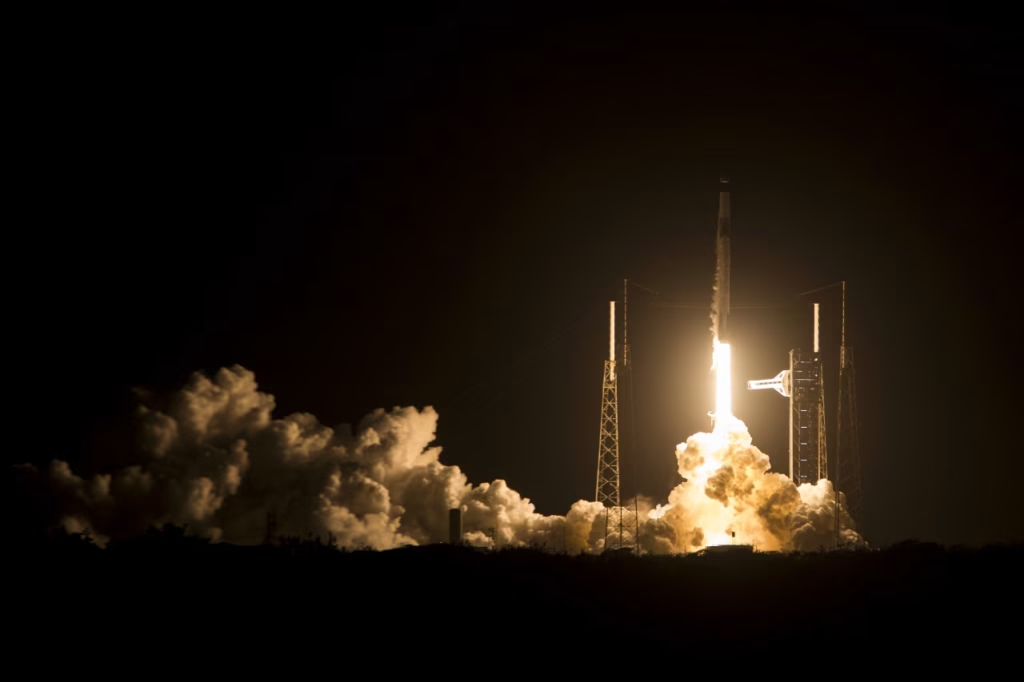
SpaceX was founded in 2002 to reduce the cost of space travel and eventually settle humans on Mars. Over two decades, it became the dominant force in private spaceflight, operating a fleet of reusable rockets and a communications network of roughly 10,000 satellites orbiting Earth, the Starlink service that now provides internet access to millions of users, including in remote and conflict-affected regions.
But the company that would go public today looks very different from that original vision. In February, SpaceX completed its acquisition of xAI, Musk’s artificial intelligence research company, in a deal that valued the combined entity at $1.25 trillion. The conglomerate now includes xAI and X, the social media platform formerly known as Twitter. This means a public investor buying SpaceX shares would effectively be buying a stake across rockets, satellites, AI infrastructure, and social media, all under one roof, all under Musk’s control.
That last point is not a minor detail. The concentration of influence, government contracts, and cross-business relationships has drawn significant scrutiny. Analysts and commentators have noted that the conflicts of interest tied to the listing are, in one description, staggering.
The Valuation Question
On the valuation itself, market analysts are sceptical but not dismissive. Shay Boloor, chief market strategist at Futurum Equities, told Reuters: “Starlink is the only reason this valuation is defensible.” Starlink has moved from an experimental service to a genuine global telecommunications business, and it carries the weight of justifying nearly two trillion dollars in implied worth.
Musk had long maintained that SpaceX would not pursue a public listing until its Starship rocket had reached Mars. The demand for capital has changed the equation. The company now needs the funds to finish developing Starship, the fully reusable heavy-lift rocket central to both its commercial future and NASA’s plans for returning humans to the Moon while also replenishing ageing Starlink satellites and funding the computing infrastructure required to run xAI’s AI models. Musk has also spoken about an ambition to build a network of up to one million data centre satellites that would operate in space itself.
Reports suggest the IPO’s ultimate success may be tied closely to the outcome of upcoming Moon missions, and the space industry is in a rare moment of intensity with NASA’s Artemis II mission having just launched four astronauts toward the Moon this week; the entire sector is drawing attention that it has not seen since the original space race.