
Artemis II Splashdown: Crew Returns Safely After Historic Lunar Mission
Quick Reads
- NASA’s Artemis II crew safely splashed down in the Pacific Ocean on April 10, completing the first crewed lunar mission in over 50 years.
- The four astronauts; Reid Wiseman, Victor Glover, Christina Koch, and Jeremy Hansen, travelled farther from Earth than any humans since the Apollo era.
- Their Orion spacecraft survived extreme heat during re-entry, reaching about 2,760°C, with a brief communication blackout before landing safely.
- The mission made history: Glover became the first person of colour to orbit the Moon, Koch the first woman, and Hansen the first non-American. NASA confirmed the mission was successful and said it paves the way for future crewed Moon missions, including a planned landing in 2028.
Artemis II Splashdown
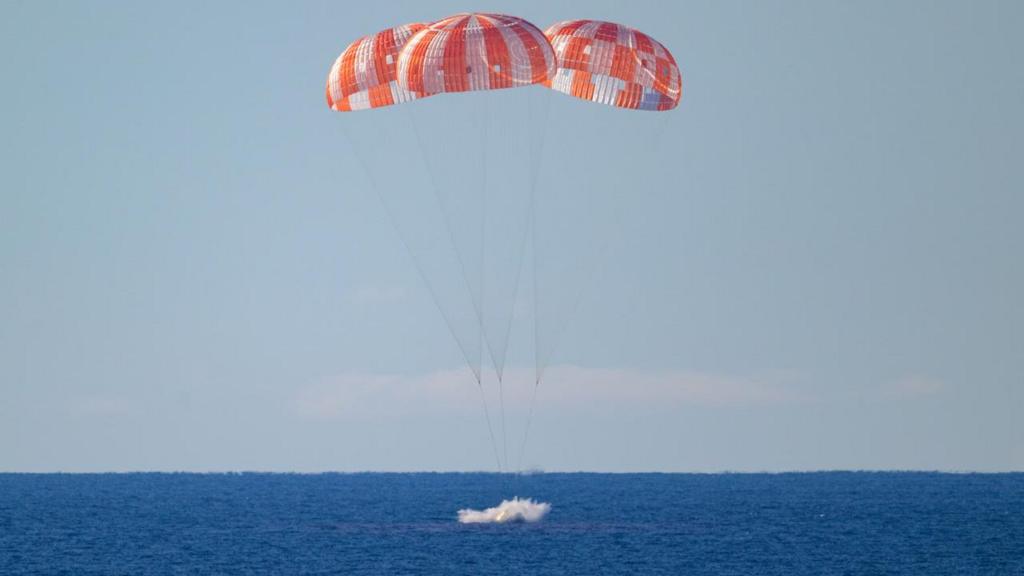
Four astronauts in the Artemis II spacecraft have splashed down safely in the Pacific Ocean, closing out the first crewed mission to travel around the Moon since the final Apollo flight more than half a century ago. The Orion spacecraft touched down off the coast of California at 5:07pm local time, 00:07 GMT, on Friday, April 10, following a high-speed re-entry through Earth’s atmosphere. Recovery teams aboard the USS John P. Murtha moved quickly to secure the capsule and extract the crew.
On board were NASA astronauts Reid Wiseman, Victor Glover, and Christina Koch, along with Canadian Space Agency astronaut Jeremy Hansen. All four were reported to be in good condition, with only minor communication issues noted after hatch opening.
A 13-Minute Descent Through Fire
The capsule endured a dramatic 13-minute descent, slamming into the atmosphere at extreme speed. Temperatures on its exterior climbed to about 2,760 degrees Celsius, hot enough to generate a plasma layer that briefly cut off communications with the crew. Contact was restored as parachutes deployed, bringing the spacecraft down to a 19 mph splashdown velocity.
The crew hit the atmosphere travelling at Mach 32, 32 times the speed of sound, a speed not seen in crewed spaceflight since NASA’s Apollo moonshots of the 1960s and 1970s. The heat shield, a critical piece of technology closely watched by engineers after performance concerns on the 2022 uncrewed test flight, performed as expected this time.
Just before re-entry, mission commander Wiseman radioed mission control: “We got a great view of the Moon out window 2 – looks a little smaller than yesterday.” Houston replied: “Guess we’ll have to go back.”
Records Broken, History Made
Launched from Florida on April 1, the crew broke Apollo 13’s distance record, reaching 252,756 miles from Earth, the farthest any humans have ever travelled from our planet. The mission did not land on the Moon or enter lunar orbit, but it completed a free-return flyby trajectory around the far side, with the crew documenting features of the lunar surface never previously seen by the naked human eye.
Glover became the first person of colour to travel around the Moon, Koch the first woman, and Hansen the first non-American. During the journey, the crew also witnessed a total solar eclipse, an event their launch date made possible, which Glover described as something that “just blew all of us away.”
In an emotional moment, the crew asked permission to name a pair of lunar craters after their Orion capsule, Integrity, and Wiseman’s late wife, Carroll.
The Artemis II mission was always a test flight, a live demonstration of the Orion capsule’s life-support, navigation, and heat-shield systems under real crewed conditions. Engineers will now analyse data from every phase of the journey to prepare for future missions.
Under the revamped Artemis program, next year’s Artemis III will see astronauts practize docking their capsule with a lunar lander in Earth orbit. Artemis IV will then attempt to land a crew near the Moon’s south pole in 2028.
NASA chief Jared Isaacman, speaking from the recovery ship, summed up the mood: “We are back in the business of sending astronauts to the moon, bringing them back safely and set up for a series more.”
Wiseman’s final words from the mission captured something larger than the technical milestone. “We really hoped in our soul is that we could for just a moment have the world pause and remember that this is a beautiful planet and a very special place in our universe, and we should all cherish what we have been gifted,” he said.